

M10 High-Speed Steel
I. Chemical Composition of M10 High-Speed Steel

II. Properties and Applications
M10 is a molybdenum-series high-speed steel characterized by fine carbides, good toughness, excellent wear resistance, and favorable red hardness. After quenching and tempering, its hardness reaches ≥ 64 HRC.
Applications: drills, milling cutters, broaches, gear cutters, stamping dies, etc. It is suitable for machining difficult-to-cut materials such as stainless steel and heat-resistant steels.
III. Metallographic Structure
M10 high-speed steel: coarse carbide particle size and eutectic carbide non-uniformity

Grain size and tempered structure of M10: using quenching at 1195°C + tempering at 560°C for 2 hours, 3 times

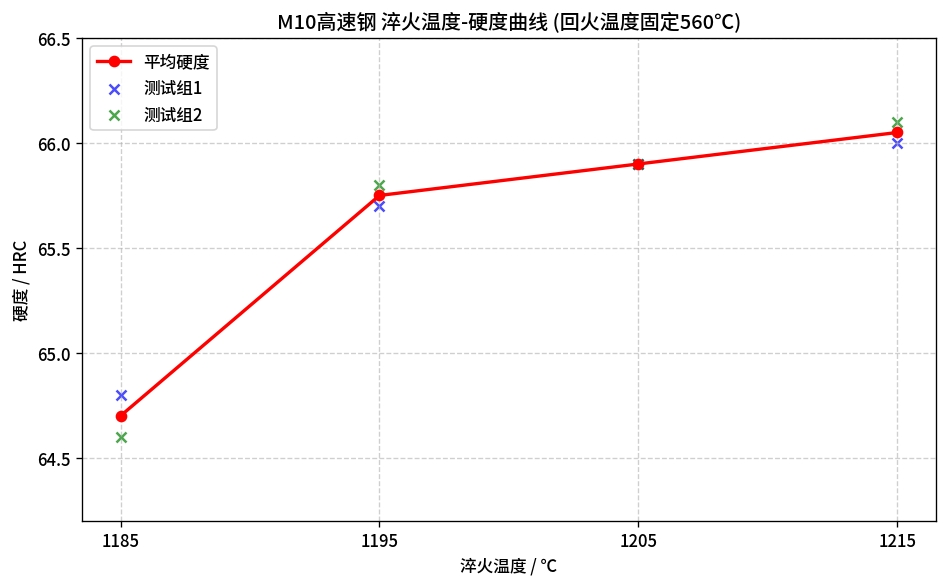
IV. Quenching Temperature – Hardness Curve
The hardness values and corresponding curves for M10 after heat treatment (560°C × 2 h × 3 times) are as follows:

V. Wear Resistance Test
Test plan: Comparative testing of M2 and M10 using white corundum as the friction medium on a friction tester.
Heat treatment process: M10 specimens of different specifications were quenched at 1185°C and 1195°C respectively, followed by tempering at 560°C for 2 hours, 3 times.

VI. Cutting Tool Test (Actual Case) – 6542 vs. M10
Basic test conditions:
Product name: ground drill
Comparison materials: 6542 / M10
Workpiece material: 40Cr, hardness 28–30 HRC
Clamping method: rigid chuck
Cooling method: full-synthetic cutting fluid
Machine model: VCM650
Cutting method: blind hole
1. Test data for φ7.0 drill

2. Test data for φ8.0 drill

3. Test data for φ10.0 drill

4. Test data for φ12.7 drill

Wear images:
M10 wear images
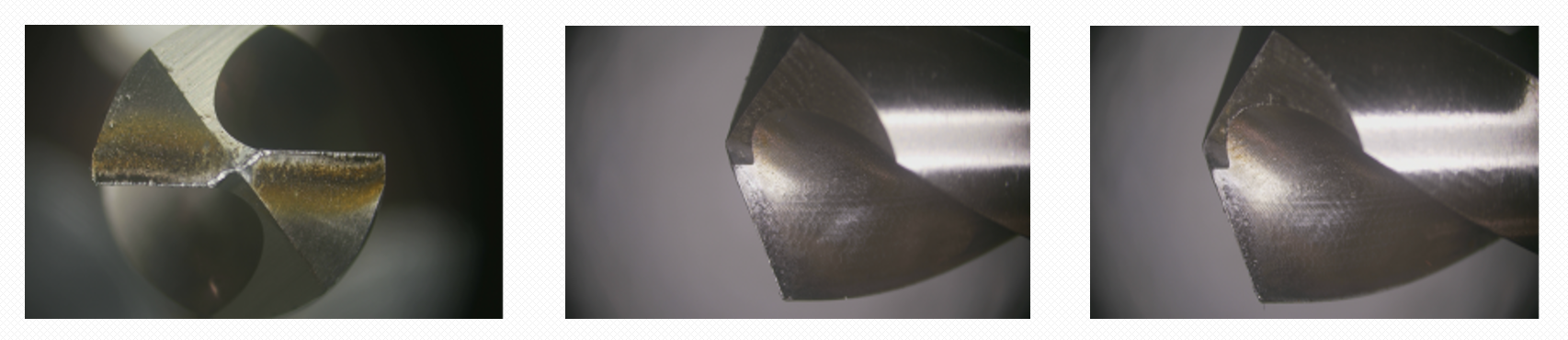
M2(6542) wear images

VII. Test Conclusions
M10 ground drills were quenched at 1185°C and 1195°C respectively, and uniformly tempered at 560°C for 2 hours, 3 times. Metallographic examination and cutting performance tests were then conducted.
Recommended heat treatment process: quenching at 1195°C + tempering at 560°C for 2 hours, 3 times.
Under this process, M10 exhibits the best combination of mechanical properties and wear/cutting performance, and its overall performance is superior to that of M2 (6542) high-speed steel.