

TGE4 (W1Mo8Cr4VCo3) High-Speed Steel
I. Chemical Composition (Alternative to Grade M35)

II. Properties
TGE4 (W1Mo8Cr4VCo3) exhibits good toughness, strong resistance to chipping and impact. With 3% cobalt content, it offers good red hardness and high-temperature wear resistance.
III. Metallurgical Structure
Grain size and tempered structure of TGE4: using 1190°C quenching + 560°C × 2h × 3 times tempering.

IV. Quenching Temperature – Hardness Curve
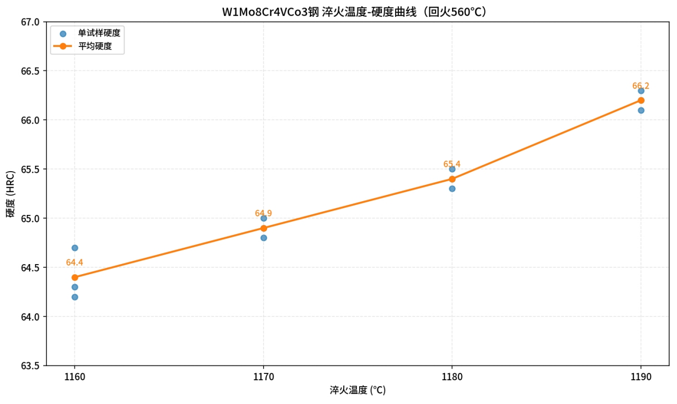
For TGE4 heat treatment using 560°C × 2h × 3 times, hardness values and the corresponding curve are shown below.

V. CCT Curve

As observed in Figure 1, at a cooling rate of 25 °C/s, the martensite transformation start temperature is 266 °C; at a cooling rate of 0.4 °C/s, the bainite transformation temperature range is 278–433 °C; at a cooling rate of 0.04 °C/s, the pearlite transformation temperature range is 665–820 °C.
VI. Wear Resistance Test
Test plan: Comparison between M35 and TGE4, using boron nitride as the friction medium, with comparative wear resistance test parameters.
TGE4 heat treatment schemes: using 1170°C and 1190°C quenching, both followed by 560°C × 2h × 3 times tempering.

VII. Cutting Tool Test (Practical Case) – M35 vs. TGE4
Basic test conditions:
Product name: ground straight-flute drill; compared materials: M35 vs. TGE4
Workpiece material: 40Cr, hardness 30 HRC
Clamping method: rigid collet; cooling method: full synthetic cutting fluid
Machine model: VCM650; cutting method: blind hole drilling

Wear images:
M35 wear images

TGE4 wear images

VIII. Test Conclusions
Test results and recommended heat treatment temperature for ground drills:
Through quenching TGE4 ground drills at two temperatures, 1170°C and 1180°C, followed by tempering at 560°C, metallographic examination and cutting tool tests were conducted. The recommended heat treatment process is 1180°C + 560°C × 2h × 3 times tempering. Under this temperature combination, the material exhibits excellent performance, surpassing that of M35.