

YSTG-MT
I. Product Overview and Market Positioning of YSTG-MT
1. Market positioning: positioned as an alternative to DC53 in the field of high-precision stamping and blanking dies.
YSTG-MT is designed with reference to the chemical composition of Daido DCMX, with reduced Cr and Mo contents combined with lower carbon content, resulting in reduced carbide quantity and size, and achieving a more balanced trade-off between toughness and wear resistance.
2. Machinability optimization: hardness and toughness are comparable to DC53.
Conventional DC53 has S ≤ 0.01%; by increasing S content to 0.07–0.12%, it is modified for improved machinability, achieving more than twice the machinability of DC53.
3. Recommended application scenarios for customer material selection: high-precision stamping and blanking dies.
YSTG-MT is more suitable for high-precision, complex thin-wall dies, addressing the issues of DC53 such as difficulty in machining high-precision complex thin-wall components, high machining costs, as well as heat treatment distortion caused by high carbon and high alloy content, fracture of slender parts, and edge chipping of thin walls.
II. Chemical Composition and Technical Characteristics of YSTG-MT

YSTG-MT is designed with reference to the chemical composition of Daido DCMX, with reduced Cr and Mo contents combined with lower carbon content, resulting in reduced carbide quantity and size, and achieving a more balanced trade-off between toughness and wear resistance. It does not pursue maximum wear resistance but prioritizes toughness, enabling overall service life to surpass DC53 under conditions prone to die chipping. Conventional DC53 has S ≤ 0.01%; by increasing S content to 0.07–0.12%, it is modified for improved machinability, achieving more than twice the machinability of DC53.
III. Metallurgical Structure of YSTG-MT

IV. Application Fields of YSTG-MT

YSTG-MT is more suitable for high-precision, complex thin-wall dies, as well as cold-work dies requiring high chipping resistance, low heat treatment distortion, and long fatigue life (e.g., precision punches, high-speed cold stamping, thin-sheet blanking).
Pain point solutions: addresses DC53's issues such as difficulty in machining high-precision complex thin-wall components, high machining costs, as well as heat treatment distortion caused by high carbon and high alloy content, fracture of slender parts, and edge chipping of thin walls.
V. Machinability Test of YSTG-MT
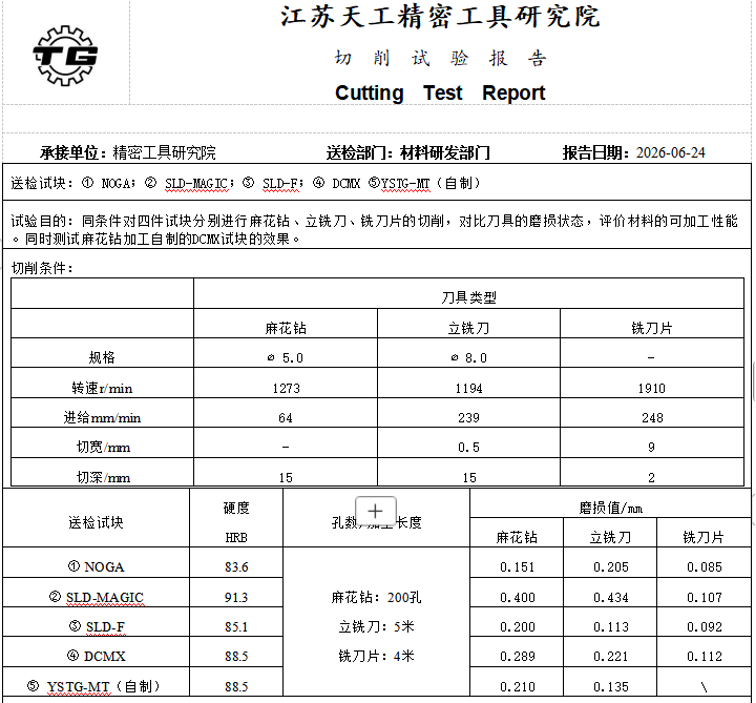

Sulfur-containing steel refining with improved sulfide inclusion morphology: VD (vacuum degassing) + calcium wire feeding (calcium treatment) can modify and control MnS sulfide inclusions, effectively reducing the formation of elongated sulfide inclusions.
VI. Heat Treatment Process Curve of YSTG-MT

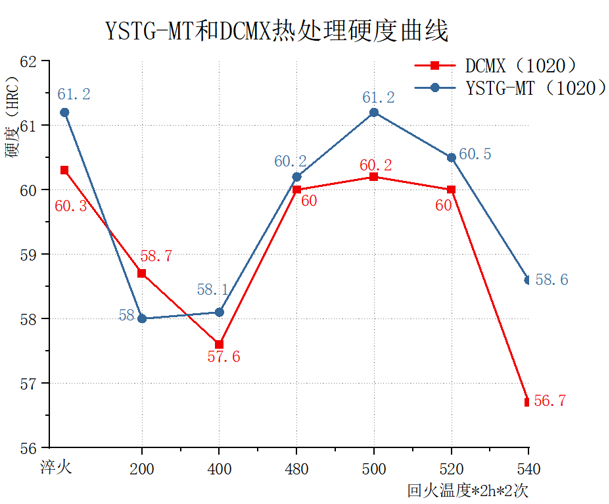
Recommended heat treatment: 1020–1030°C quenching + 505–515°C tempering, achieving a hardness of HRC 60–62, providing a balance between wear resistance and toughness, and suitable for high-precision complex-cavity blanking dies.