

Summary of High-Speed Steels M10, M7, and W1Mo8Cr4VCo3
I. Chemical Composition

II. Properties and Applications
M10: Belongs to the molybdenum-series high-speed steel. Characterized by fine carbides, good toughness, excellent wear resistance, and good red hardness. Quenched and tempered hardness is ≥64 HRC.
Applications: Drills, milling cutters, broaches, gear cutting tools, stamping dies, etc. Suitable for machining difficult-to-cut materials such as stainless steel and heat-resistant steels.
M7: After heat treatment, this steel achieves extremely high hardness, effectively resisting wear during processing and significantly extending tool life.
Applications: Used in various high-load, high-precision machining scenarios.
III. Metallography
M10: Ø11mm – Large particle carbide size, eutectic carbide segregation rating.

M7: Ø8mm – Large particle carbide size, eutectic carbide segregation rating.

M10 Grain Size & Tempered Structure: Ø11mm, using 1195°C quenching + 560°C * 2h * 3 times tempering.

M7 Grain Size & Tempered Structure: Ø8mm, using 1190°C quenching + 560°C * 2h * 3 times tempering.

IV. Quenching Temperature - Hardness Curve
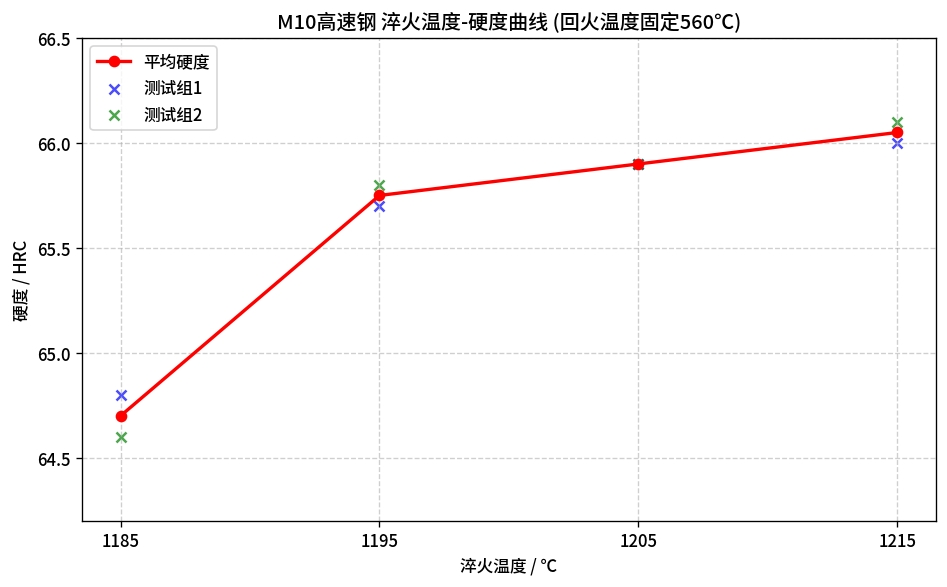
M10: Heat treatment using 560°C * 2 hours * 3 times. Hardness values and corresponding curve are shown below.

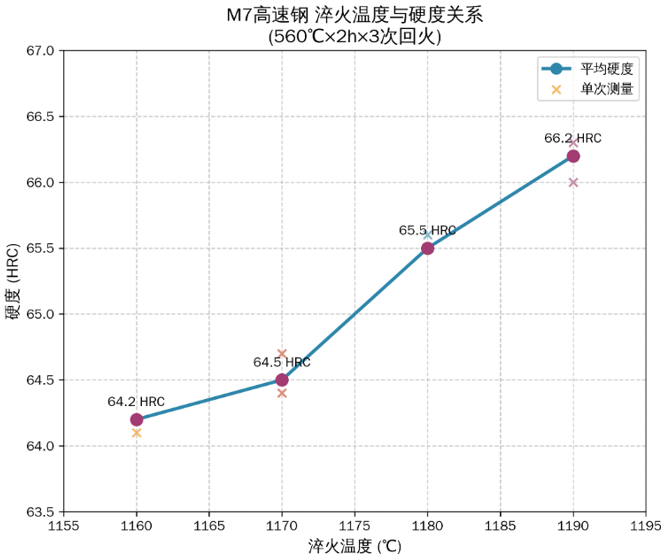
M7: Heat treatment using 560°C * 2h * 3 times. Hardness values and corresponding curve are shown below.

V. Wear Resistance Testing
M10 vs. M2:
Test Plan: Comparison between M2 and M10 using white corundum as the friction medium on a friction tester.
Heat Treatment: M10 specimens of different specifications were quenched at 1185°C and 1195°C respectively, followed by tempering at 560°C * 2h * 3 times.

M7 vs. M2:
Test Plan: Comparison between M2 and M7 using white corundum as the friction medium on a friction tester.
Heat Treatment: M7 specimens of different specifications were quenched at 1160°C, 1170°C, and 1190°C respectively, followed by tempering at 560°C * 2h * 3 times.

VI. Cutting Tool Tests (Practical Case Studies)
6542 vs. M10
Basic Test Conditions:
Product: Ground drill; Materials Compared: 6542 / M10
Workpiece Material: 40Cr, Hardness 28-30 HRC
Clamping: Rigid chuck; Cooling: Full synthetic cutting fluid
Machine Model: VCM650; Cutting Method: Blind hole
1. Ø7.0 drill test data

2. Ø8.0, Ø10.0 drill test data

3. Ø12.7 drill test data

Wear Images
M10 wear images
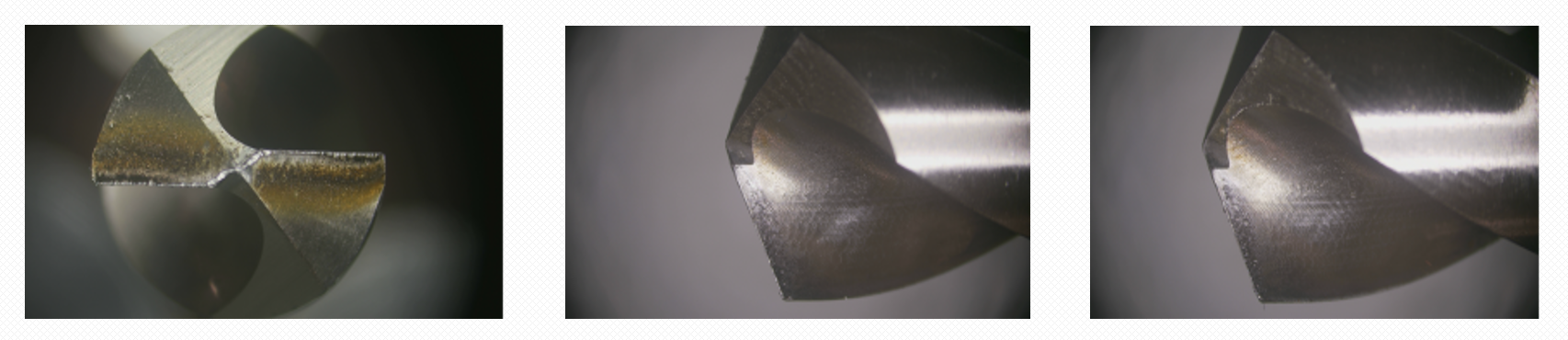
M2 (6542) wear images

6542 vs. M7
Basic Test Conditions:
Product: Ground drill; Materials Compared: 6542 / M7
Workpiece Material: 40Cr, Hardness 28-30 HRC
Clamping: Rigid chuck; Cooling: Full synthetic cutting fluid
Machine Model: VCM650; Cutting Method: Blind hole
1. Ø6.0 drill test data

VII. Test Conclusions
M10: M10 ground drills were quenched at 1185°C and 1195°C, uniformly tempered at 560°C × 2h × 3 times, and then subjected to metallographic and cutting performance tests.
Recommended Heat Treatment Process: 1195°C quenching + 560°C holding for 2 hours, tempered 3 times.
Under this process, M10 exhibits the best comprehensive mechanical properties, wear resistance, and cutting performance, overall superior to M2 (6542) high-speed steel.
M7: Based on cutting tool tests on M7 ground drills, 1190°C + 560°C * 2h * 3 times is the recommended heat treatment process. At this temperature combination, the material's properties are optimal and can exceed the performance of M2 (6542).
VIII. W1Mo8Cr4VCo3 High-Speed Steel Chemical Composition (Equivalent to Grade M35)

W1Mo8Cr4VCo3 possesses good toughness, excellent resistance to chipping and impact. Contains 3% cobalt, providing good red hardness and high-temperature wear resistance.
IX. Metallography
W1Mo8Cr4VCo3 Grain Size & Tempered Structure: Ø8mm, using 1190°C quenching + 560°C * 2h * 3 times tempering.

X. Quenching Temperature - Hardness Curve
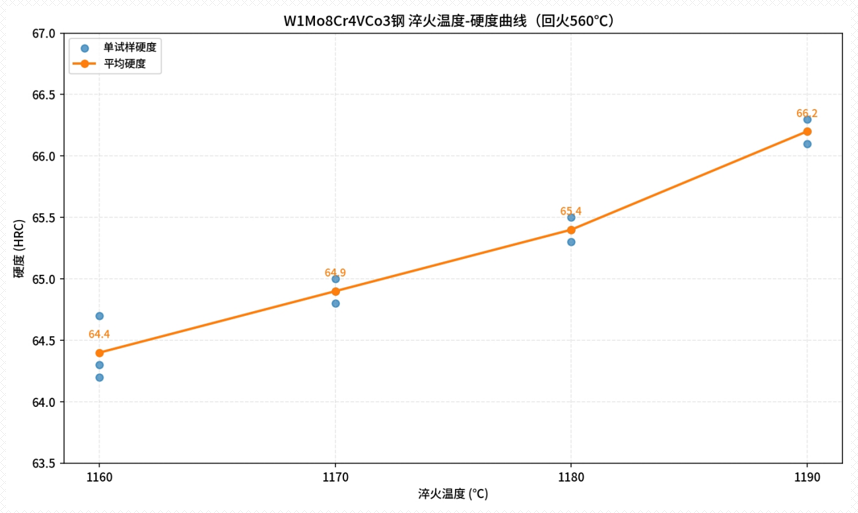
W1Mo8Cr4VCo3: Heat treatment using 560°C * 2h * 3 times. Hardness values and corresponding curve are shown below.

XI. Wear Resistance Testing
Test Plan: Comparison between M35 and W1Mo8Cr4VCo3 using boron nitride as the friction medium. Wear resistance test parameters were compared.
W1Mo8Cr4VCo3 Heat Treatment: Specimens were treated using 1170°C and 1190°C quenching, followed by tempering at 560°C * 2h * 3 times.
