

Powder Metallurgy Steel TPM5616
I. Chemical Composition

II. Properties
Advantages of TPM5616: It is the grade with the highest alloy content among powder metallurgy high-speed steels, with a total alloy content exceeding 40%. It represents the state-of-the-art in hardness for this class, achieving a quenched and tempered hardness of 68–70 HRC, and can even reach up to 72 HRC. Compared to other powder metallurgy high-speed steels in the same series, it offers superior wear resistance and top-tier red hardness. The Co16% + W11 + V6 combination enables it to maintain high cutting hardness even at 600–700°C. Its performance in dry cutting and high-speed cutting at elevated temperatures is superior to lower-cobalt grades.
III. Application Areas
Cutting Tools:
Taps, milling cutters, and other cutting tools, particularly for machining difficult-to-cut materials such as hardened steel (HRC 65+), titanium alloys, and Metal Matrix Composites (MMCs – composites where ceramic particles or fibers are added to metals like aluminum or magnesium, characterized by being lightweight, hard, and wear-resistant).
Complex tools and form cores: gear hobs, gear shaper cutters, broaches, and integral tools with steps or helical flutes – applications where cemented carbides are difficult to sinter due to shape complexity, and traditional HSS lacks sufficient wear resistance. This grade fits perfectly into this application window, especially for dry cutting operations.
Mold and Die Applications:
Precision / high-wear resistance cold-work dies: precision blanking dies for high-silicon electrical steel sheets and high-hardness stainless steel, precision fine blanking, high-speed precision fine blanking, cold heading, drawing, cold extrusion, powder compacting, etc.
IV. Metallography
As-quenched microstructure morphology at different temperatures.

Tempered microstructure morphology at 560°C.

As-quenched microstructure morphology at different temperatures.

Tempered microstructure morphology at 560°C.

V. Quenching and Tempering Curves (Salt Bath)
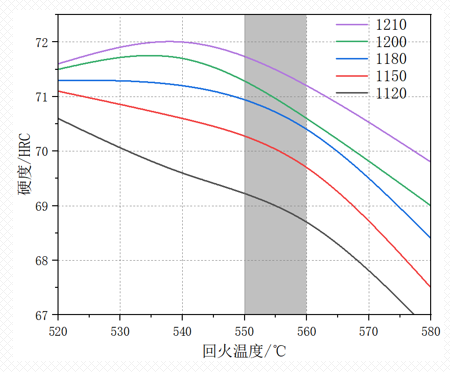
Heat Treatment Curves: Using 1210°C quenching + 540°C tempering achieves a maximum hardness of 72 HRC. The peak hardness tempering temperature for this grade is 540°C. Customers can select the quenching temperature based on the required hardness. The recommended tempering temperature range is 540–560°C, with 550–560°C being preferred to avoid the peak tempering temperature and reduce brittleness.
VI. CCT Curve
VII. Impact Toughness
Specimen Size: 10 × 10 × 55 mm

Toughness: TPM5616 exhibits lower toughness compared to TPM6711.
VIII. Wear Resistance Testing
Specimen Size: 12 × 12 × 19.05 mm
Test Parameters: Workpiece material: Boron nitride (hardness: 4500+ HV, second only to diamond in hardness). Test force: 100 N. Rotation speed: 100 rpm. Duration: 30 minutes. No heating applied.

With Cryogenic Treatment: Wear resistance improvement: TPM6711 increases by 54%; TPM5616 increases by 50%. TPM5616 shows 41% higher wear resistance than TPM6711.
Without Cryogenic Treatment: TPM5616 shows 45.9% higher wear resistance than TPM6711.
IX. Red Hardness

Exhibits high wear resistance and high red hardness, maintaining high cutting hardness at 600–700°C. Performance in dry cutting and high-speed cutting at elevated temperatures is superior to lower-cobalt grades.
X. Physical Properties
